// THE SCIENCE
Every gesture you train, every error you make, every millisecond your reaction takes — it's data about how the human brain acquires motor skill. We built Hand Solo at the Physiology of Action Lab to study that process across healthy adults, athletes, older adults and stroke survivors.
// PRESENTED AT
// APPLICATION 01 · CLINICAL — STROKE
Stroke is the most demanding application of our work — the place where understanding how people learn motor skills directly determines whether someone regains the use of their hand.
new stroke cases every year
- →
Stroke is the 2nd leading cause of death and 3rd leading cause of disability worldwide.
- →
Most clinical interventions remain expensive and require frequent in-person visits.
new cases annually in argentina
- →
After the early recovery window, nearly 50% of survivors transition to a chronic phase with persistent motor deficits.
- →
Specialized rehabilitation is concentrated in cities, leaving large rural and underserved populations behind.
// THE VISION
At the Physiology of Action Lab, we discovered that motor memory unfolds in waves over seconds, hours, and days, revealing critical windows during which well-timed interventions can amplify learning. For example, practicing within the hour before sleep increases next-day performance by 30% — a level of temporal precision that traditional clinic schedules cannot accommodate.
Living and working in a country marked by deep social and economic inequalities, these findings pushed us beyond the lab. Our vision is to translate biologically optimized training into affordable, home-based technologies that expand access to high-quality motor rehabilitation for underserved populations. By embedding neuroscience into portable digital tools, we aim to close the gap between discovery and real-world recovery through Mobile Health Technologies.
next-day performance gain · when training within 1h before sleep
LÓBULO TEMPORAL
LÓBULO OCCIPITAL
LÓBULO PARIETAL
CORTEZA PREFRONTAL
CORTEZA CEREBRAL
VENTRÍCULO LATERAL
CUERPO CALLOSO
HIPOTÁLAMO
GLÁNDULA PITUITARIA
TÁLAMO
CEREBELO
TRONCO ENCEFÁLICO
HIPOCAMPO
PUENTE DE VAROLIO
BULBO RAQUÍDEO
CORTEZA ENTORRINAL
CA1
SUBÍCULO
CA3
GIRO DENTADO
// THE HIPPOCAMPUS
A 4-centimeter arc of neurons buried in the medial temporal lobe — the hippocampus — determines whether a new experience consolidates into a lasting memory or dissolves within hours. Named after the Greek for seahorse, it is the most studied brain structure in neuroscience history. Understanding it is inseparable from understanding why timing shapes recovery.
Patient H.M. — The birth of modern memory neuroscience
Scoville & Milner (1957) · Journal of Neurology, Neurosurgery, and Psychiatry, 20(1), 11–21
In 1953, Henry Molaison (known for decades only as 'H.M.') underwent bilateral surgical removal of his hippocampi to relieve severe epilepsy. The result was profound anterograde amnesia: he could no longer form any new declarative memories. Every morning he met his caregivers as strangers. Yet he could still learn motor tasks — his performance on mirror drawing improved across sessions — he simply had no memory of having practiced. This dissociation established that the hippocampus is essential for forming new memories, but that motor learning operates through a separate system.
Memory and the hippocampus: a synthesis
Squire, L.R. (1992) · Psychological Review, 99(2), 195–231
Squire synthesized decades of lesion and behavioral studies into the Standard Model of memory consolidation: immediately after learning, memory depends critically on the hippocampus. Over weeks and months, repeated hippocampal-cortical dialogue gradually transfers the memory trace to neocortex, making it hippocampus-independent. Early in this process the memory is fragile — maximally sensitive to both disruption and enhancement. The window is real, and it closes.
Memories migrate from hippocampus to prefrontal cortex over time
Frankland & Bontempi (2005) · Nature Reviews Neuroscience, 6(2), 119–130
Using c-fos expression as a proxy for neural activity, Frankland and Bontempi showed that one day after contextual learning, memory recall strongly activates the hippocampus. Thirty-six days later, the same recall activates prefrontal cortex — with hippocampal activity drastically reduced. The memory has migrated. This temporal gradient — a biological clock encoded into consolidation itself — is the mechanistic foundation for why the timing of intervention determines how much of a newly acquired skill survives into the long term.
// BIOLOGICALLY TIMED INTERVENTIONS
Motor memory does not form in a single moment — it consolidates in cascading waves over seconds, hours, and days. Each window is a biological opportunity to amplify a newly acquired skill.
Within-session binding
In the seconds following each practice trial, the brain begins stabilizing the motor trace. Immediate repetition, feedback timing, and inter-trial intervals all modulate how strongly the pattern binds.
The pre-sleep window
Practicing within the hour before sleep triggers enhanced overnight consolidation. A Hand Solo session at 10 PM outperforms the same session at 10 AM — by about 30% next-day performance.
Sleep-dependent consolidation
During slow-wave sleep, the hippocampus replays and transfers motor sequences to the neocortex. What you practiced the night before is measurably stronger in the morning.
next-day motor performance gain · training within 1 hour before sleep vs. morning training
Sleep potentiates motor memory consolidation in humans
Journal of Neuroscience · Vol. 44, No. 36 · 2024 · e0325242024
This study directly underpins the 30% sleep-timing finding that shapes Hand Solo's design. Participants who trained before sleep showed significantly greater next-day retention of a sequential finger-tapping task compared to morning trainers — validated across healthy adults.
Read the paper →Mobile Health Technologies.
By embedding neuroscience into portable digital tools, we aim to close the gap between discovery and real-world recovery. Hand Solo is designed to be played in the hour before sleep — not as an afterthought, but as a biologically targeted intervention that any patient can access from home.
// SCIENCE OF MOTOR LEARNING — APPLICATIONS
Stroke rehabilitation is the most visible use case, but the same VR platform measures any human's motor learning curve. Every player generates a fingerprint of attention, reaction time, fine-motor accuracy and consolidation.
Older adults
Balance, gait, fine-motor control, cognitive-motor coupling. Generating fall-risk markers and early signs of subtle motor decline long before clinical thresholds.
Sleep & consolidation
Anyone who plays before sleep contributes to validating our flagship finding — practicing within an hour of bedtime potentiates motor memory by ~30% (Solano et al., 2024).
One game. Every population. The same metrics.
Reaction time, gesture accuracy, smoothness (jerk), error rate, learning slope and fatigue spectra are universal motor-learning variables. By measuring them across an athlete, a senior, a healthy 25-year-old and a stroke survivor — with the exact same instrument — we build a population atlas of motor learning.
// THE VISUAL TRACKING ENGINE
Our solution utilizes a low-cost, standalone VR headset, with hand and finger movements tracked directly by its integrated cameras. The patient's own hands become the controllers — tracked in real-time with sub-millimeter precision.
Real-time hand tracking
VR headsets employ a real-time hand-tracking AI algorithm that reconstructs joint positions using depth sensing and skeletal modeling. No buttons. No joysticks.
Custom computer vision
A custom CV algorithm detects target gestures — thumb-to-finger opposition — while actively ignoring compensatory strategies. Only precise, isolated movements register.
Unity engine
Unity continuously processes joint data to detect thumb-to-finger gestures and assess their precision, timing and consistency.
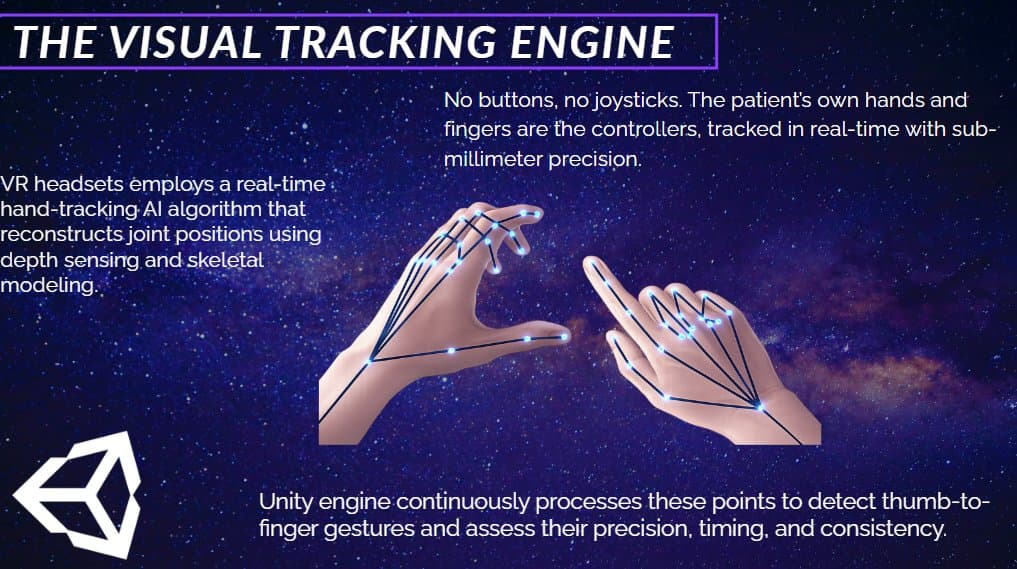
The algorithm effectively discriminated target gestures from compensatory movements. High tolerability and engagement, with learning curves showing consistent improvement.
// FOUNDING POSTER · SfN 2025
CONFERENCE POSTER · SfN 2025
A VR-based immersive rehabilitation paradigm for finger individuation at home
UNSAM-CONICET · ICIFI · SAN MARTÍN, ARGENTINA
“We developed a VR training system for accessible home-based finger individuation therapy. Our solution utilizes a low-cost, standalone VR headset, with hand and finger movements tracked directly by its integrated cameras. The immersive Unity-based game requires users to steer a spacecraft, avoiding asteroids, using discrete thumb-to-finger opposition gestures…”
“Results demonstrated high tolerability and engagement, with learning curves showing consistent improvement in gesture execution speed and precision. A pilot study with chronic (>6 months) stroke survivors is currently underway.”
CONFERENCE
Society for Neuroscience 2025
CONTROL #
2025-S-11475-SfN
KEYWORDS
Stroke · VR · CV
// CONFERENCE POSTERS
Hand Solo is the substrate of multiple ongoing studies in the lab. The first poster (SfN 2025) validated the VR system itself in healthy participants and announced a chronic-stroke pilot. The next builds on top: adding muscle signal to the loop with sEMG and AI.
Adding muscle signal to the loop
When a stroke survivor tries to move their index finger, they often co-activate the middle finger, ring finger or wrist — these are compensatory strategies that mask true recovery. Computer vision can detect where the finger ended up, but not which muscles drove it.
This work-in-progress integrates surface electromyography (sEMG) into the existing VR system. Four wireless sensors on the forearm capture muscle activation in real time. A neural network trained on healthy participants classifies the intended gesture from the EMG pattern — >95% accuracy — and is fused with hand-tracking. Together they detect, quantify and filter compensatory activity so that re-learning targets the right muscles.
4 wireless sEMG sensors
Trigno (Delsys), distal third of the forearm, targeting flexor and extensor groups. Sampled at 1 kHz, synchronized in real time with VR data streams.
RMS · ZCR · Median freq
Band-pass filtered (20–450 Hz), rectified to compute the envelope. RMS amplitude, zero-crossing rate, and median frequency for fatigue estimation.
CV + EMG · joint decoder
Late-fusion architecture: CV gesture label + EMG features fed to a gradient-boosted classifier. Live rejection of compensatory attempts.
Unity for Humanity Grant Winner
Hand Solo was selected as a 2026 winner of the Unity for Humanity Grant — awarded to projects that use real-time 3D technology to address critical humanitarian challenges. Recognition from the world's leading real-time engine developer for our mission to make motor rehabilitation accessible to everyone.
Read the announcement →